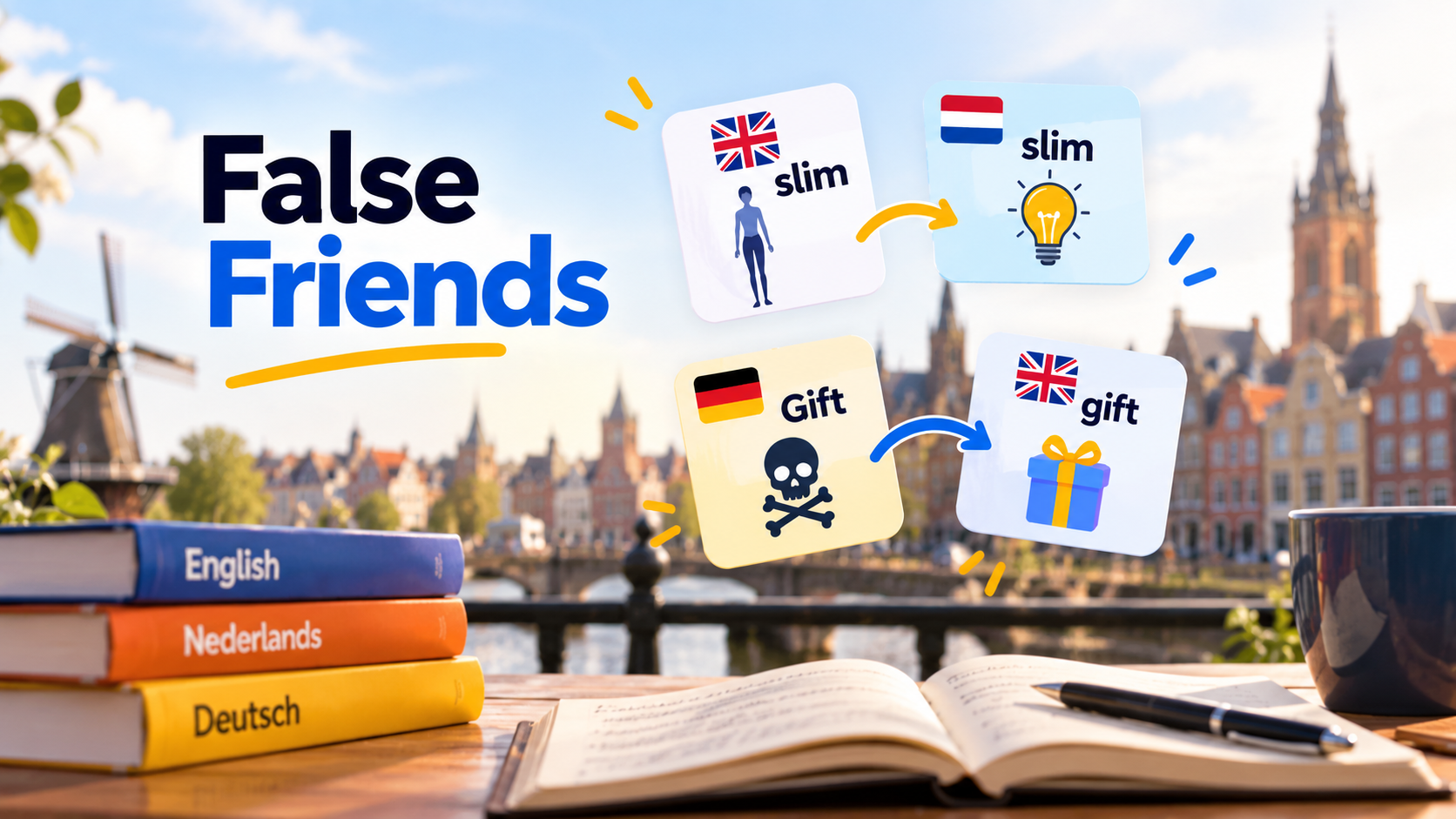
Imagine you are learning English and Dutch at the same time. One day, you come across the word slim. It looks exactly the same in both languages, so you might assume it has the same meaning.
But in English, slim describes someone who is thin or slender. In Dutch, slim means intelligent or clever.
Words like these are called false friends: words from different languages that look or sound similar but have different meanings.
For people learning multiple languages simultaneously, false friends present an interesting challenge. The more languages you learn, the more familiar-looking words you encounter. But familiarity does not always mean understanding.
Let's explore six examples from English, Dutch, and German.
1. Slim: Thin or Intelligent?
Let's start with a simple but revealing example.
English: She is slim. — She has a slender figure.
Dutch: Zij is slim. — She is intelligent.
The spelling is identical, and the sentence structures are almost the same. Yet the meanings are completely different.
In Dutch, slank describes a slim person, while slim means smart or clever.
Compare these two concepts:
- English: smart → Dutch: slim
- English: slim → Dutch: slank
Memorizing spelling alone makes confusion easy. Understanding the meaning behind each word helps you build more accurate connections.
2. Actual, Actueel, Aktuell: Real or Current?
Another common trap appears across three languages.
English: actual — real, factual, existing in reality.
Dutch: actueel — current, topical, or up-to-date.
German: aktuell — current or up-to-date.
Consider these examples:
The actual cost is higher. — The real cost is higher.
Dit onderwerp is actueel. — This topic is currently relevant.
The similarity makes these words look like direct translations. However, the English word actual is often closer to Dutch werkelijk or echt, and German tatsächlich in the appropriate context.
Meanwhile, English current frequently corresponds to Dutch actueel and German aktuell.
This illustrates an important principle: words that look related do not necessarily have the same meaning today.
3. Eventually and Eventueel: Finally or Possibly?
This false friend can change the meaning of an entire sentence.
English: Eventually, we found the answer.
Meaning: We found the answer after some time.
Dutch: Eventueel kunnen we later beginnen.
Meaning: We can start later if necessary.
German: Wir können eventuell später anfangen.
Meaning: We may possibly start later.
English eventually describes something that happens in the end, often after a delay or difficulty.
Dutch eventueel and German eventuell, however, express possibility or a condition.
This distinction matters in everyday conversations, professional communication, and scheduling. Confusing "eventually" with "possibly" can completely change the message you intend to communicate.
4. Kind: Friendly or Child?
The word kind appears in English, Dutch, and German, but its meaning depends on the language.
English: She is very kind. — She is friendly and considerate.
Dutch: Het kind speelt buiten. — The child is playing outside.
German: Das Kind spielt draußen. — The child is playing outside.
In English, kind can mean friendly or considerate. It can also refer to a type or category.
In Dutch and German, kind / Kind means a child.
This example demonstrates why multilingual learners should pay attention not only to spelling, but also to grammatical function, meaning, and context.
5. Wie: Who or How?
Even closely related languages can surprise learners.
In Dutch:
Wie ben jij? — Who are you?
In German:
Wie heißt du? — What is your name?
The Dutch word wie means "who", while the German word wie means "how".
The German equivalent of "who" is wer, while the Dutch equivalent of "how" is hoe.
Because Dutch and German share many similarities, learners may automatically transfer familiar words from one language into the other.
Sometimes this works. Sometimes it leads to completely different meanings.
6. Gift: A Present or Poison?
One of the most memorable examples comes from English and German.
In English, gift means a present.
I bought a gift.
But the German noun Gift means poison.
Das ist Gift. — That is poison.
Interestingly, Dutch gift can mean a donation or gift, while poison is usually called gif.
These differences demonstrate why familiar-looking vocabulary should never be trusted without checking its meaning.
Why Do False Friends Matter When Learning Multiple Languages?
When learning just one foreign language, people usually compare new vocabulary with their native language.
But when learning three or more languages, the situation becomes more complex.
You might recognize a word in English, remember a similar German word, and then try to use it in a Dutch sentence.
Sometimes these connections make learning faster. But they can also create confusion.
The solution is to learn meanings and their relationships across languages, rather than memorizing isolated word forms.
Here are five practical strategies:
- Verify similar-looking words. Never assume identical spelling means identical meaning.
- Learn words in context. Short sentences reveal how words are actually used.
- Compare meanings across languages. Focus on what each word expresses, not just how it looks.
- Keep track of confusing vocabulary. Build a personal collection of false friends.
- Review difficult examples regularly. Repeated comparison can help reinforce the correct associations.
How ParallelLingvo Supports Multilingual Learning
The idea of comparing multiple languages is central to ParallelLingvo, an application designed for learning three or more languages in parallel.
Instead of creating separate vocabulary lists for every language pair, ParallelLingvo organizes translations around a shared vocabulary concept.
For example, consider the meaning "intelligent":
- English: smart
- Dutch: slim
- German: intelligent / klug
Now compare the meaning "slender":
- English: slim
- Dutch: slank
- German: schlank
By organizing vocabulary around meanings rather than spelling, learners can see which words actually correspond to one another.
ParallelLingvo also supports personal vocabulary collections, helping learners focus on the words most relevant to their studies, work, and daily life.
This approach is especially useful for students, international families, migrants, professionals, and anyone learning multiple languages at the same time.
The key principle is simple: learn the meaning, not just the letters.
Conclusion
False friends are more than amusing linguistic coincidences. They reveal how complex and fascinating the relationships between languages can be.
As we learn more languages, recognizing subtle differences becomes increasingly important.
Parallel language learning offers an opportunity to compare vocabulary, identify misleading similarities, and develop a deeper understanding of how different languages express the same ideas.
One word. Multiple languages. One learning flow.
Discover a more connected approach to multilingual vocabulary learning with ParallelLingvo.