Learning more than one language at the same time often creates an unexpected problem: your vocabulary becomes fragmented.
You may have one list for English and Dutch, another for Dutch and German, another for English and Spanish, and perhaps a separate notebook or app for every new language you add. Before long, the same concept appears several times in different places.
ParallelLingvo is being designed around a different idea.
Instead of treating every language pair as a separate vocabulary list, ParallelLingvo connects multiple translations to the same word or concept.
One concept instead of many separate lists
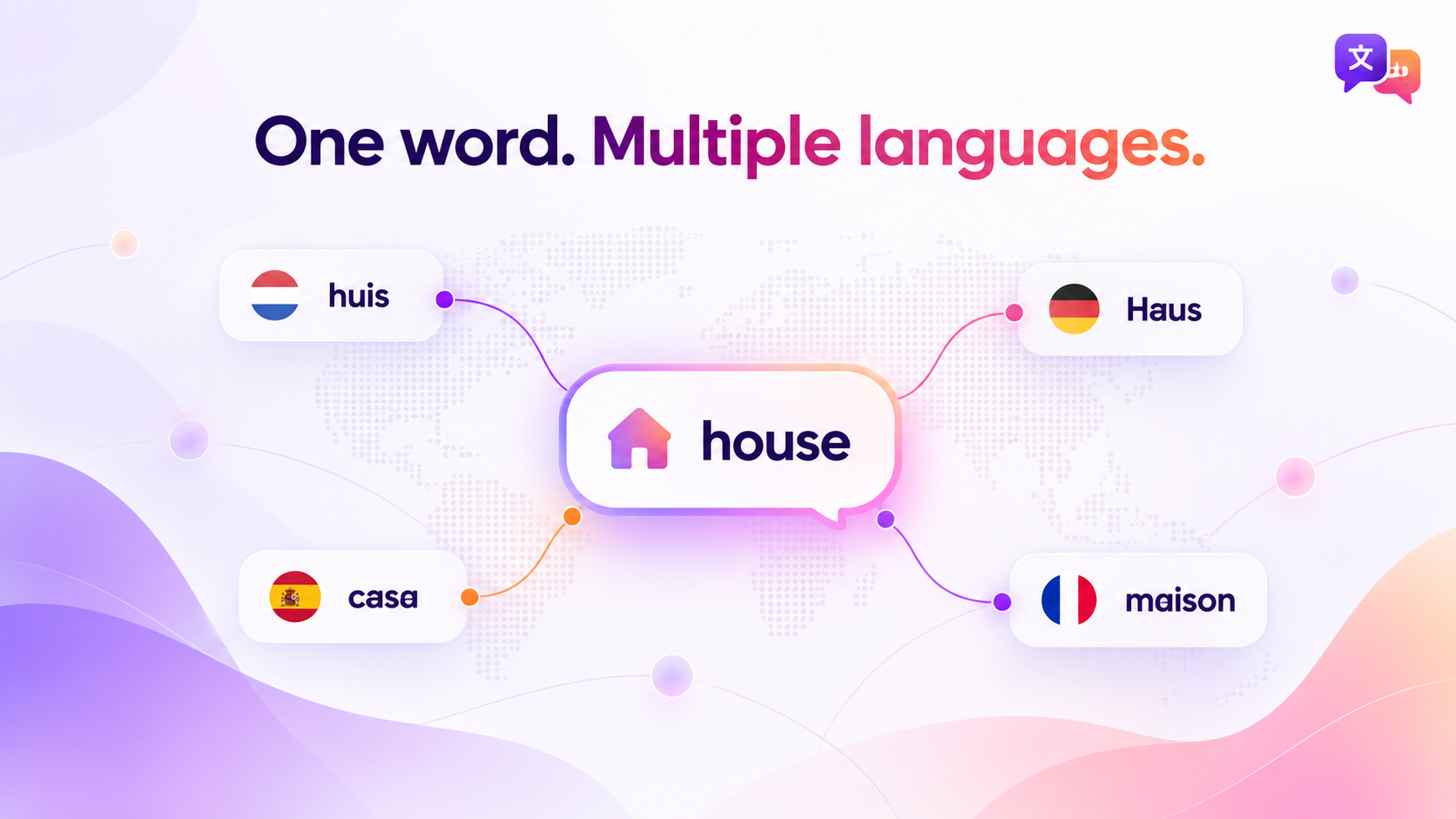
Imagine that you want to learn the word “house”.
In a traditional language-learning system, you might save it several times:
English → Dutch English → German English → Spanish Dutch → German
But the concept itself has not changed. It is still the same word you are trying to understand and remember.
ParallelLingvo approaches vocabulary from the concept first.
One vocabulary concept can be connected to translations in multiple languages. This means a learner can study the same idea across several languages without creating duplicate entries for every possible language pair.
The goal is simple: make multilingual learning easier to organize.
Designed for people who learn several languages
ParallelLingvo is intended for learners who do not necessarily study only one foreign language.
This can include international families, migrants, students, travelers, professionals working across different countries, or people preparing for language exams.
For example, someone living in the Netherlands may use Dutch every day, English at work, and another language with family. For this learner, dividing vocabulary into completely separate systems is not always the most natural approach.
ParallelLingvo keeps those languages inside one learning environment.
Users can create their own lessons and vocabulary collections, add translations in the languages they need, listen to pronunciation, mark difficult words, and return to them during later practice.
Seeing connections between languages
Learning several languages together is not only about storing more translations.
It can also help learners notice relationships.
Some words look similar across languages. Others may share the same origin but have slightly different meanings. Sometimes one language uses a single word where another language needs an entire expression.
When translations are visible together, those differences become easier to notice.
Instead of switching between several independent vocabulary lists, the learner can compare languages directly and build a clearer mental connection between them.
This is especially useful when the learner already knows one foreign language and wants to use that knowledge while studying another.
Your own lessons, your own vocabulary
Not every learner needs the same vocabulary.
A student preparing for an exam may need academic words. Someone starting a new job may need professional terminology. A parent may want vocabulary related to school, healthcare, or everyday life.
ParallelLingvo allows users to build their own lessons and word collections around the topics that matter to them.
Difficult words can be marked for additional review, pronunciation can be practiced with audio, and progress can be followed over time.
The purpose is not to force every learner through the same fixed course. The system is intended to support a personal vocabulary that grows together with the learner.
One learning flow
ParallelLingvo is being built as a multilingual learning system rather than a collection of independent bilingual dictionaries.
The underlying idea is simple:
One word. Multiple languages. One learning flow.
Instead of repeatedly creating the same vocabulary for different language pairs, learners can keep related translations together and focus on actually learning them.
For people who regularly use or study several languages, this can make vocabulary practice more structured, more connected, and easier to maintain.
ParallelLingvo is available as a web application and Telegram Mini App, with further platforms planned as the project develops.