You learn a new word today. You understand its meaning, repeat it several times, and feel confident that you know it. But a few days later, when you need that word in a conversation, it suddenly disappears from your memory.
This is one of the most common frustrations in language learning. And when you're studying several languages simultaneously, remembering vocabulary can become even more challenging.
The solution isn't necessarily to learn more words. It's to change how you practice the ones you've already learned.
Recognizing a Word Is Not the Same as Remembering It
There is an important difference between recognizing a word when you see it and recalling it without help.
For example, you might easily understand a Dutch word while reading a sentence. But when someone asks you a question, you may struggle to produce that same word.
Reading vocabulary lists creates familiarity. Actively recalling words helps strengthen your ability to use them.
That's why effective vocabulary practice should involve more than repeatedly looking at translations.
Give Difficult Words More Attention
Not every word requires the same amount of practice.
Some words become familiar almost immediately. Others are confusing, difficult to pronounce, or easily mixed up with similar words in another language.
Instead of spending equal time on everything, identify the words that consistently cause problems.
With ParallelLingvo, learners can mark difficult words and return to them for additional practice.
This makes it easier to focus attention where it's needed most.
Connect Vocabulary Across Languages
When learning three or more languages, maintaining separate vocabulary lists for every language pair can become unnecessarily complicated.
ParallelLingvo approaches vocabulary differently.
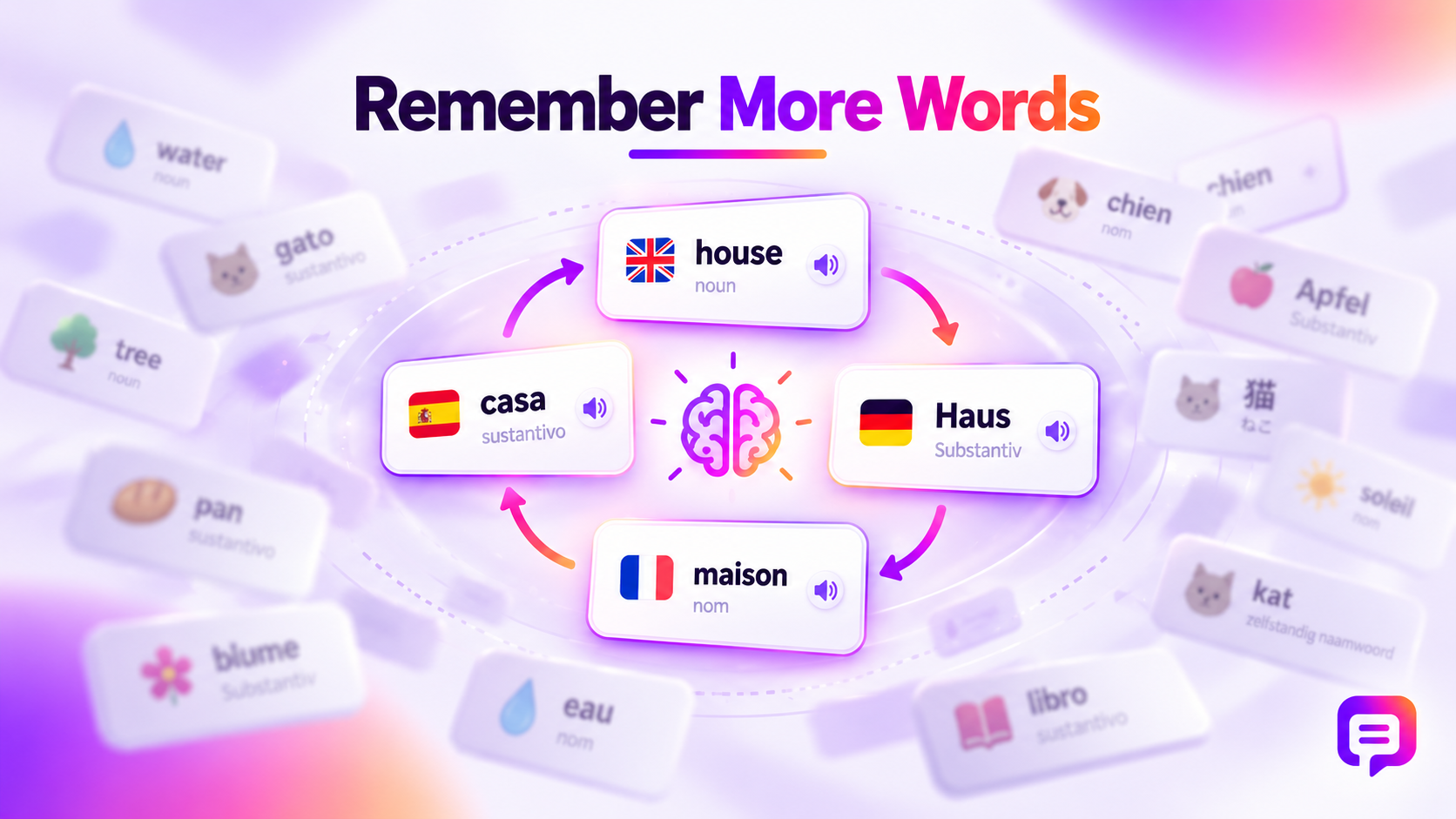
A single vocabulary concept can connect translations across several selected languages. Instead of treating each translation as an isolated entry, you can study related words together while paying attention to differences in meaning and usage.
This approach helps organize multilingual learning and reduces the need to manage multiple independent word lists.
Use Pronunciation to Strengthen Learning
Vocabulary isn't only about written words.
Hearing how a word sounds and practicing its pronunciation adds another dimension to learning.
ParallelLingvo includes audio and pronunciation features that help learners connect written vocabulary with spoken language.
Try listening to a word, saying it aloud, and recalling its meaning without immediately checking the translation.
Review Regularly, Not Just Once
A single study session rarely makes every new word permanently accessible.
Returning to vocabulary over time gives you more opportunities to retrieve it from memory.
A practical routine might include:
- Reviewing recently learned words.
- Practicing words you've marked as difficult.
- Testing yourself before checking translations.
- Returning to vocabulary from earlier lessons.
Short, focused practice sessions can be more useful than repeatedly rereading long lists without testing your memory.
Build a Learning Routine That Works for You
ParallelLingvo is a multilingual vocabulary learning application designed for people studying three or more languages in parallel.
It combines personal lessons and vocabulary collections, pronunciation support, difficult-word marking, review, and progress tracking within one learning environment.
Whether you're preparing for a language examination, adapting to life in another country, or simply learning several languages out of curiosity, the goal remains the same: turn familiar vocabulary into words you can actually remember and use.
Learning more words is useful. Remembering and using them is what makes the difference.
Explore ParallelLingvo and start building your own multilingual learning routine.
https://learn.iovenko.eu/